


Introduction: Why Learn Jokes in Spanish?
If you’ve ever wanted to truly connect with Spanish-speaking culture, learning jokes in Spanish is one of the most joyful ways to do it. Humor is the heartbeat of any language — it reveals what a culture values, how people think, and how they play with words. Whether you’re a beginner trying to crack your first chiste (joke) or a fluent speaker looking for the funniest Spanish puns and one-liners, this ultimate collection has something for everyone.
Jokes in Spanish — known as chistes en español — range from clever wordplay (juegos de palabras) to silly knock-knock jokes (toc toc), absurdist humor, and sharp wit. Spanish humor tends to celebrate irony, family dynamics, everyday struggles, and the delightful ambiguity of the language itself.
Beyond entertainment, funny Spanish jokes are also a fantastic language-learning tool. Research consistently shows that humor boosts memory retention, makes vocabulary stick faster, and lowers the anxiety that often comes with learning a new language. When you laugh while learning, you learn better.
In this article, we’ve compiled 200+ jokes in Spanish across 10+ categories, complete with English translations, tips for understanding Spanish humor, and answers to the most common questions people ask about chistes en español. Let’s dive in — ¡Empecemos!
Table of Contents
1. Short and Easy Jokes in Spanish (Chistes Cortos)
Short jokes in Spanish are perfect for beginners. They use simple vocabulary and give you a quick confidence boost. Here are some of the best chistes cortos en español:
Beginner-Friendly Spanish Jokes
- ¿Qué le dice un jardinero a otro? “¡Que te mejores!” (What does one gardener say to another? “Get mulch better!” — mejores = get better / me flores = my flowers)
- ¿Por qué los pájaros no usan Facebook? “Porque ya tienen Twitter.” (Why don’t birds use Facebook? Because they already have Twitter.)
- ¿Qué hace una abeja en el gimnasio? “¡Zum-ba!” (What does a bee do at the gym? Zumba! — zum = buzz)
- ¿Cómo se llama el campeón de buceo de Japón? “Tokofondo.” (What’s the name of Japan’s diving champion? “Tokobottom” — tocó el fondo = touched the bottom)
- ¿Cuál es el colmo de un electricista? “Que su mujer se llame Luz y su hijo Tomás.” (What’s the worst thing for an electrician? His wife is named Luz (light) and his son Tomás (tomas = power sockets).)
- ¿Qué le dice el semáforo al coche? “¡No me mires que me estoy cambiando!” (What does the traffic light say to the car? “Don’t look at me, I’m changing!”)
- ¿Cómo se dice “biblioteca” en inglés? “Bookstore? No, librería, y no mires mi libreta.” (Bilingual mix-up joke about false cognates.)
- ¿Qué hace un pez cuando está aburrido? “Nada.” (What does a fish do when it’s bored? Nothing. / It swims. — “nada” means both “nothing” and “it swims”)
- ¿Por qué el libro de matemáticas estaba triste? “Porque tenía demasiados problemas.” (Why was the math book sad? Because it had too many problems.)
- ¿Qué le dijo el océano al barco? “Nada.” (What did the ocean say to the boat? Nothing. / It swam. — Same brilliant double meaning.)
- ¿Cómo se dice “galleta” en inglés? “Cookie. ¿Y cómo se dice “Cookie” en español? ¡Galleta, ya te lo dije!”
- ¿Cuál es el animal más antiguo? “La cebra, porque está en blanco y negro.” (Which is the oldest animal? The zebra, because it’s in black and white.)
- ¿Qué hace una vaca cuando baila? “¡Muuu-ve las caderas!” (What does a cow do when it dances? It moves — moo-ves — its hips!)
- ¿Por qué las focas miran siempre al cielo? “Por si acaso llueven peces.” (Why do seals always look at the sky? Just in case it rains fish.)
- ¿Cuál es el superhéroe más ordenado? “Spiderman, porque todo lo tiene atado.” (Which superhero is most organized? Spiderman, because he has everything tied up.)
2. Funny Wordplay Jokes in Spanish (Juegos de Palabras)
Spanish is a language rich in double meanings and homophones, making juegos de palabras (wordplay jokes) especially clever and funny.
- ¿Qué le dijo el 0 al 8? “¡Bonito cinturón!” (What did the 0 say to the 8? “Nice belt!”)
- ¿Por qué el espantapájaros ganó un premio? “Porque era sobresaliente en su campo.” (Why did the scarecrow win an award? Because he was outstanding in his field.)
- ¿Cuál es el colmo de un reloj? “Que le den la hora.” (What’s the worst thing for a clock? Being told the time — it should know!)
- ¿Qué le dijo el papel a la tijera? “Aquí te corto.” (What did the paper say to the scissors? “I cut you off here” — also means “I end things with you here.”)
- ¿Cómo se llama el hijo del sol? “Solito.” (What’s the sun’s son called? “Little sun” — solito also means “all alone.”)
- ¿Por qué los astronautas usan Linux? “Porque no pueden usar Windows en el espacio.” (Why do astronauts use Linux? Because you can’t use Windows in space.)
- ¿Cómo se dice “agua” en japonés? “No sé, pero si lo sabes, dímelo porque tengo mucha sed.”
- ¿Qué tienen en común un árbol y una computadora? “Los dos tienen hojas de cálculo.” (What do a tree and a computer have in common? They both have spreadsheets — “hojas” means leaves AND sheets.)
- ¿Qué hace el viento cuando tiene frío? “Se pone a silbar.” (What does the wind do when it’s cold? It whistles.)
- ¿Por qué el banco estaba tan relajado? “Porque tenía muchos ríos cerca.” (Why was the bank so relaxed? Because it had many rivers nearby — “banco” means both bank and bench, and “banco de río” means riverbank.)
- ¿Qué le dijo el pastel a la vela? “¡Me estás sacando de quicio!” (What did the cake say to the candle? “You’re driving me crazy!” — also, “quicio” relates to the hinge of a door.)
- ¿Cuál es el colmo de un cartero? “Que su hijo se llame Camilo y su mujer se llame Carta.” (Wordplay on the mailman’s name and mail-related words.)
- ¿Qué le dijo el semáforo a la moto? “¡Para!” (What did the traffic light say to the motorcycle? “Stop!” — also, “para” can mean “for you.”)
- ¿Qué se dice cuando un globo toca la cima de una montaña? “¡Cumbreeeee!” (pincha) (What do you say when a balloon touches a mountain peak? “Summit!” — also a pop sound, since “cumbre” = summit and a balloon pops at the peak.)
- ¿Por qué el libro fue al médico? “Porque tenía muchas páginas en blanco y el doctor dijo que era anemia.”
3. Animal Jokes in Spanish (Chistes de Animales)
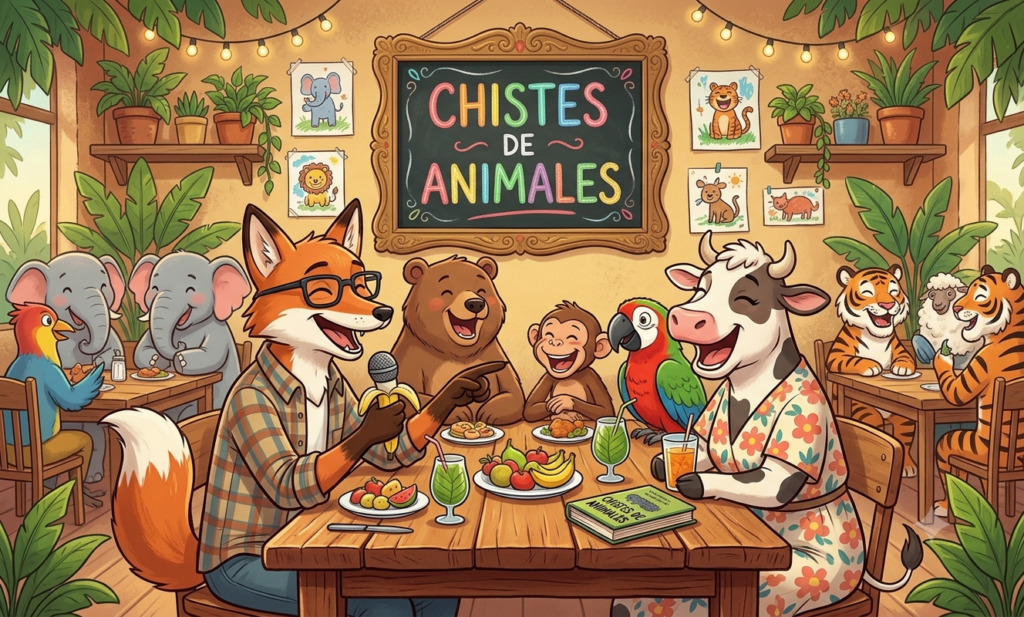
Animal jokes — chistes de animales — are universally beloved and work perfectly in Spanish.
- ¿Qué le dice un jaguar a otro? “¡Jaguar you!” (What does one jaguar say to another? “Jaguar you!” — sounds like “How are you?”)
- ¿Qué le dice un perro a un hueso? “¡Te voy a roer!”
- ¿Por qué el gato se sentó en la computadora? “Porque quería tener el ojo en el mouse.” (Why did the cat sit on the computer? To keep an eye on the mouse.)
- ¿Cómo se llama el perro de un mago? “¡Labracadabrador!” (What’s a magician’s dog called? Labracadabrador!)
- ¿Qué hace un elefante encima de una biblioteca? “¡Nada, pesa demasiado!” (What does an elephant do on top of a library? Nothing — it’s too heavy!)
- ¿Por qué el pollito cruzó la carretera? “¡Para demostrar que no era un cobarde!” (Why did the chick cross the road? To prove it wasn’t a coward!)
- ¿Qué hace una araña en internet? “Página web.” (What does a spider do on the internet? A webpage — “web” means both web and spider web.)
- ¿Por qué las jirafas tienen el cuello largo? “Porque sus pies huelen muy mal.” (Why do giraffes have long necks? Because their feet smell terrible.)
- ¿Cuál es el animal que mejor karate sabe? “El canguro, porque siempre lleva la bolsa de golpes.” (Which animal is best at karate? The kangaroo — it always carries its punching bag.)
- ¿Qué le dice una iguana a su gemela? “Somos iguanas.” (What does an iguana say to its twin? “We’re iguanas” — sounds like “We’re the same.”)
- ¿Cómo se ríe una serpiente? “Jijijijiji.” (How does a snake laugh? Hisssss-hissss-ssss.)
- ¿Por qué el caballo no puede usar el teléfono? “Porque no tiene dedo.” (Why can’t a horse use a phone? Because it has no finger — “dedo” = finger/toe.)
- ¿Qué le dice un gusano a otro gusano? “Voy a dar una vuelta a la manzana.” (What does one worm say to another? “I’m going around the apple block.”)
- ¿Por qué el pez no puede usar el ordenador? “Porque le teme al ratón.” (Why can’t the fish use a computer? Because it fears the mouse.)
- ¿Qué hace un burro cuando llueve? “Se moja.” (What does a donkey do when it rains? It gets wet.)
4. Doctor and Patient Jokes in Spanish
Medical humor is a staple of Spanish comedy. Here are some classic chistes de médico:
- Paciente: Doctor, me duele cuando levanto el brazo así. Doctor: Pues no lo levante así.
- Paciente: Doctor, tengo problemas de memoria. Doctor: ¿Desde cuándo? Paciente: ¿Desde cuándo qué?
- Doctor: Tiene usted que dejar de fumar, beber y salir con mujeres. Paciente: ¿Y me voy a curar? Doctor: No, pero la muerte le parecerá más aceptable.
- Paciente: Doctor, me siento como un perro. Doctor: ¿Desde cuándo? Paciente: Desde cachorro.
- Doctor: Usted tiene que perder 20 kilos. Paciente: ¿De verdad? Doctor: Sí, pero primero, ¿puede bajarse de mi escritorio?
- Paciente: Doctor, creo que soy una nevera. Doctor: ¿Por qué? Paciente: Porque cada vez que abro la boca, la gente mete la mano.
- Paciente: Doctor, me he tragado un bolígrafo, ¿qué hago? Doctor: Espere sentado, ahora voy.
- Médico: ¿Fuma usted? Paciente: No. Médico: ¿Bebe alcohol? Paciente: No. Médico: ¿Hace ejercicio? Paciente: Tampoco. Médico: ¿Entonces para qué quiere vivir más?
- Paciente: Doctor, soy adicto al Twitter. Doctor: Lo siento, no lo sigo.
- Enfermera: Doctor, el hombre invisible está en la sala de espera. Doctor: Dígale que no puedo verle ahora.
5. School and Student Jokes in Spanish (Chistes de Escuela)
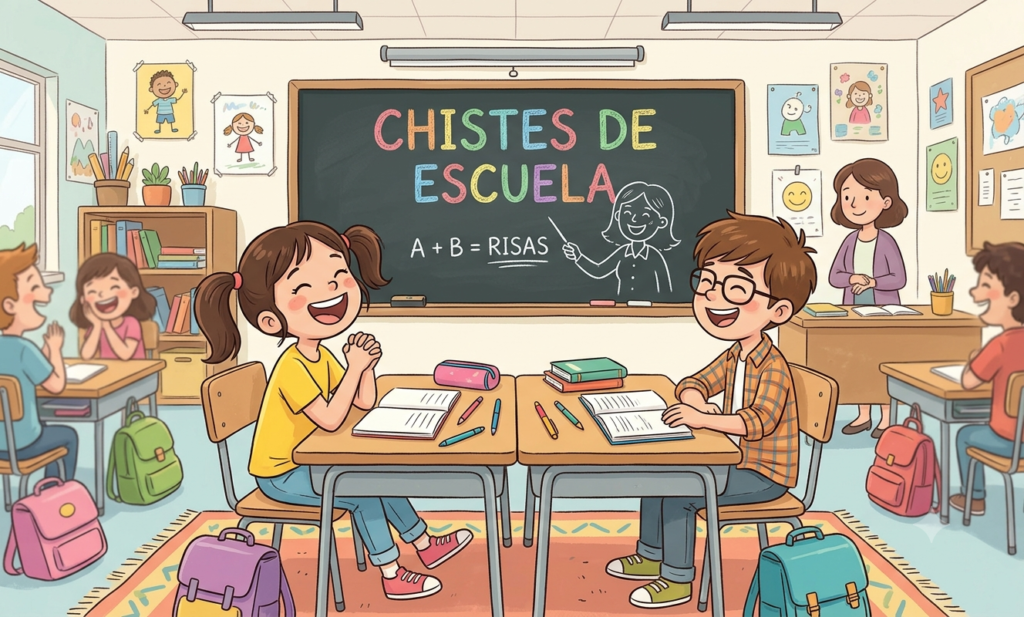
Every Spanish speaker remembers these classic chistes de escuela:
- Profesor: Juan, ¿cuánto es 7 x 8? Juan: 54. Profesor: ¡Incorrecto! Juan: Sí, pero ¡es el más cerca que he estado!
- Maestro: María, use “pez” y “pelota” en una oración. María: El pez juega a la pelota.
- Profesor: ¿Cuál es la capital de Francia? Alumno: La F.
- Profesor: Si tienes 12 manzanas y te como 4, ¿cuántas te quedan? Alumno: Doce. ¡No le voy a dar ninguna!
- Maestra: Carlos, ¿por qué llegas tarde? Carlos: Porque usted dijo que no corriera por los pasillos.
- Profesor: El que sabe la respuesta que levante la mano. Alumno: ¿Y el que no sabe? Profesor: Que levante las dos.
- Profesora: ¿Qué hacen los verbos? Alumno: Nada, son palabras.
- Papá: ¿Sacaste buenas notas? Hijo: Sí, igual que Abraham Lincoln. Papá: ¿Cómo así? Hijo: En historia.
- Maestra: ¿Quién inventó el avión? Pepe: ¡Los hermanos Rifle! Maestra: ¿Rifle? ¿No será Wright? Pepe: Sí, eso, Raifo.
- Profesor: ¿Cuántos lados tiene un círculo? Alumno: Dos: el de adentro y el de afuera.
6. Food Jokes in Spanish (Chistes de Comida)
Food is central to Latin and Spanish culture — naturally, chistes de comida are delicious:
- ¿Qué le dijo la hamburguesa al ketchup? “¡Para ya, que me estás poniendo rojo!”
- ¿Por qué la naranja fue al médico? “Porque no se encontraba zumo.” (Because it wasn’t feeling juicy — “zumo” = juice.)
- ¿Cómo se llama un queso que no es tuyo? “Nacho.”
- ¿Qué le dijo una fresa a la otra? “¡Fresa-nse por favor!” (What did one strawberry say to the other? Freshen up — “fresa” = strawberry.)
- ¿Por qué el tomate es rojo? “Porque vio la ensaladera.” (Why is the tomato red? Because it saw the salad bowl.)
- ¿Qué hace una pizza en el banco? “Pedir un préstamo de masa.” (What does a pizza do at the bank? Ask for a dough loan — “masa” = dough/mass.)
- ¿Cómo se llama la sandía en inglés? “Watermelon. ¿Y cómo le dices que no la quieres? Waternolon.”
- ¿Por qué el café fue al psicólogo? “Porque tenía muchos granos de ansiedad.”
- ¿Qué hace un huevo cuando le entra frío? “Se entiesa.” (What does an egg do when it gets cold? It stiffens — also sounds like “it hardens with cold.”)
- ¿Por qué el pan nunca gana al ajedrez? “Porque siempre está en jaque.” (Why does bread never win at chess? Because it’s always in check — “jaque” = check in chess.)
7. Family Jokes in Spanish (Chistes de Familia)
Family is everything in Spanish-speaking culture, and these chistes de familia prove it:
- Hijo: Papá, ¿puedo salir a jugar? Papá: ¿Con ese pelo? Hijo: No, con mis amigos.
- Mamá: ¿Por qué no estudias? Hijo: Porque ya sé todo lo que hay en los libros. Mamá: Entonces, ¿por qué no sabes nada?
- Abuelo: Cuando era joven, yo también hacía locuras. Nieto: ¿Sí? ¿Como cuáles? Abuelo: Me casé con tu abuela.
- Esposa: ¿Me escuchas cuando te hablo? Esposo: Sí, sí. Esposa: ¿Y qué dije? Esposo: Lo de antes.
- Mamá: ¿Cuántas veces te he dicho que no hagas eso? Hijo: No sé, no llevo la cuenta.
- Papá: ¿Qué aprendiste hoy en la escuela? Hijo: Que no aprendí suficiente, tengo que volver mañana.
- Hija: Mamá, ¿me das dinero para una heladería? Mamá: ¡Pero si acabas de desayunar! Hija: Lo sé, pero el helado es el postre del desayuno.
- Esposa: Este matrimonio es un fracaso. Esposo: Sí, lo sé. ¿Y cuándo empezamos?
- Abuela: Cuando yo era joven, los hombres me daban flores. Abuelo: Sí, para que no volvieran.
- Hijo: Papá, soy homosexual. Papá: ¡Esto no puede ser! ¿Qué dirá tu madre? Hijo: Que lo mismo le dije.
8. Knock-Knock Jokes in Spanish (Toc Toc)
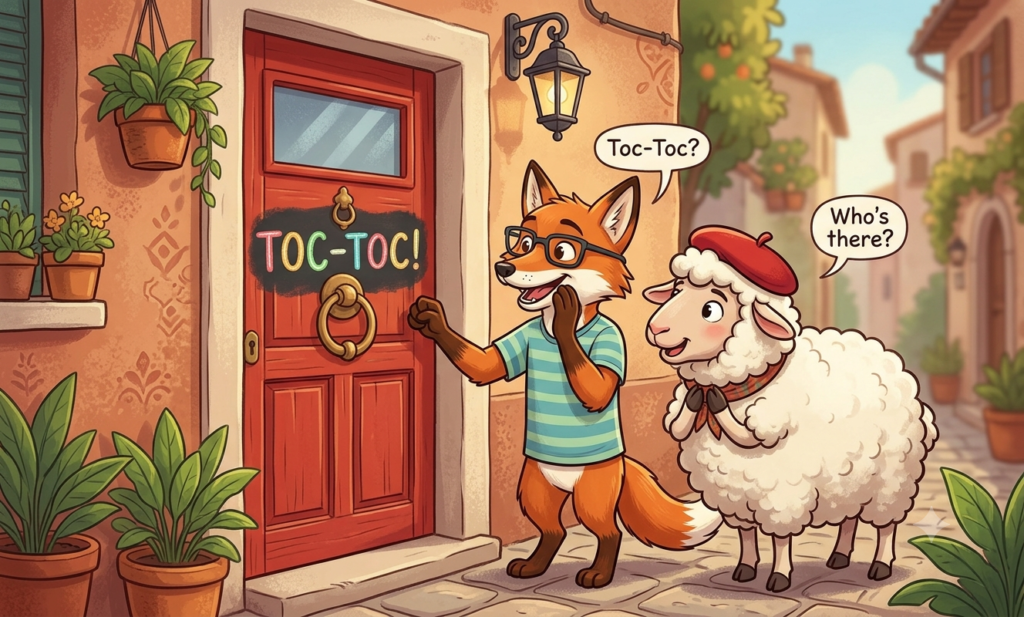
Toc toc jokes are the Spanish equivalent of knock-knock jokes, and children (and adults) adore them:
- — Toc, toc. — ¿Quién es? — Interrumpiendo va. — ¿Interrumpiendo va—? — ¡Muu! (Classic “interrupting cow” joke.)
- — Toc, toc. — ¿Quién es? — Óscar. — ¿Óscar quién? — ¡Óscar que me abras la puerta, que hace frío!
- — Toc, toc. — ¿Quién es? — La policía. — ¿La policía quién? — La policía que investiga sus deudas.
- — Toc, toc. — ¿Quién es? — Amazon. — ¿Amazon quién? — Amazon Prime. Tu paquete llegó.
- — Toc, toc. — ¿Quién es? — Una vaca. — ¿Una vaca quién? — Una vaca loca que quiere entrar a tu casa.
- — Toc, toc. — ¿Quién es? — Boo. — ¿Boo quién? — ¡No llores, solo es un chiste!
- — Toc, toc. — ¿Quién es? — Un fantasma. — ¿Un fantasma quién? — ¡Buuuuu!
- — Toc, toc. — ¿Quién es? — Nadie. — Pero, ¿quién es? — Nadie, te digo. Me comí la llave.
- — Toc, toc. — ¿Quién es? — Interrumpiendo vacas dos. — ¿Interr—? — ¡Muuuu! ¡Les dije que volvería!
- — Toc, toc. — ¿Quién es? — Felipe. — ¿Felipe quién? — ¡Felipe la llave que me muero de frío!
9. Spanish Jokes for Kids (Chistes para Niños)
These clean, funny chistes para niños are perfect for children learning Spanish or native young speakers:
- ¿Qué hace una abeja cuando tiene frío? “¡Se pone el zum-brero!” (What does a bee do when it’s cold? It puts on its beehat — zum + sombrero.)
- ¿Cómo se llama el superhéroe de la fruta? “¡Súper Mango!”
- ¿Por qué el dinosaurio no podía hablar? “Porque estaba extintuado.” (Because it was “extincted” — child language mix-up joke.)
- ¿Qué le dijo el lápiz al papel? “Escribo para ti.” (What did the pencil say to the paper? “I write for you.”)
- ¿Cuál es el rey de los útiles escolares? “El regla.” (What’s the king of school supplies? The ruler — “regla” = ruler/rule.)
- ¿Qué le dijo el triángulo al círculo? “No tiene caso hablar contigo, no tienes ángulos.” (What did the triangle say to the circle? “There’s no point talking to you, you have no angles.”)
- ¿Por qué el sol nunca va a la universidad? “Porque ya tiene un millón de grados.” (Why does the sun never go to university? Because it already has a million degrees.)
- ¿Qué hace el número 1 cuando tiene sed? “Busca un 0 para tomar un 10 con agua.” (What does the number 1 do when thirsty? Looks for a 0 to make a 10 with water.)
- ¿Por qué Peppa Pig no puede ir a la playa? “Porque la arena le hace jamón.” (Why can’t Peppa Pig go to the beach? Because the sand turns her into ham.)
- ¿Qué hace un pato cuando ve a otro pato en el espejo? “Cuac-uac.” (Double quack.)
10. Dark and Sarcastic Spanish Humor
Spain and Latin America both have a rich tradition of humor negro (dark humor). These are for mature audiences:
- ¿Cuál es el colmo de un suicida? “Tirarse de un edificio y sobrevivir. Bueno, hasta la acera.”
- ¿Qué le dice un vegano a otro vegano? “Nada, solo esperan que lo preguntes tú primero.” (What does one vegan say to another? Nothing — they’re waiting for you to ask first.)
- ¿Cómo se llama el nuevo restaurante de la Luna? “No tiene mucha comida, pero tiene una vista excelente.” (What’s the new restaurant on the Moon called? No much food, but the view is out of this world.)
- ¿Qué hace un mago cuando está enojado? “¡Se convierte en un prestidigitador de palabras!”
- ¿Cómo sabes que un chiste es de mal gusto? “Cuando lo tienes que explicar… como este.” (How do you know a joke is in poor taste? When you have to explain it… like this one.)
11. Classic Spanish One-Liners
- “Soy tan mala cocinera que hasta el humo pide ayuda.”
- “No soy vago, estoy en modo ahorro de energía.”
- “Mi cama y yo somos muy compatibles. Es mi jefe el problema.”
- “Dicen que el tiempo es oro. Entonces yo soy oro en banca.”
- “Soy tan olvidadizo que una vez casi me olvido de olvidar algo.”
- “El optimista ve el vaso medio lleno. El pesimista lo ve medio vacío. Yo lo veo en el lugar equivocado.”
- “Soy tan puntual que llego tarde por adelantado.”
- “Nací inteligente, pero la educación lo fue arreglando.”
- “Mi cartera llora cuando la abro. Tiene lágrimas de vacío.”
- “Cambié todas mis contraseñas por ‘incorrecto’. Así, cuando la olvido, el sistema me lo recuerda.”
- “Trabajo 8 horas y duermo 8 horas. El problema es que son las mismas.”
- “No procrastino. Solo priorizo mis futuros planes de acción con flexibilidad temporal.”
- “La pereza es la madre de todos los inventos. Sin ella, nadie hubiera inventado el mando a distancia.”
- “Tengo una memoria excelente. Solo falla cuando necesito recordar algo.”
- “Mi actitud frente a los problemas: si no tiene solución, no es un problema. Y si la tiene, tampoco.”
12. Regional Spanish Jokes (España vs. Latinoamérica)
Spanish humor varies significantly by country and region. Here’s a taste:
Chistes de España
- ¿Qué diferencia hay entre un madrileño y un yogur? “Que el yogur tiene más cultura.”
- ¿Por qué los catalanes no comen pulpo? “Porque no se lo pueden permitir con tanto brazo.”
- ¿Cómo se dice “siesta” en inglés? “No se dice. Se hace.”
Chistes de México
- ¿Cuál es el colmo de los mexicanos? “Que el taco de carnitas se les caiga al suelo.”
- ¿Por qué los mexicanos siempre llegan tarde? “Porque el que llega primero paga la cuenta.”
- ¿Cómo sabe un mexicano que la fiesta fue buena? “Cuando amanece en otro estado.”
Chistes de Argentina
- ¿Cuántos argentinos hacen falta para cambiar una bombilla? “Uno para sujetar la bombilla y el resto para girar el mundo alrededor de ellos.”
- ¿Por qué los argentinos nunca miran al cielo? “Porque podrían caerse del pedestal.”
Chistes de Colombia
- ¿Cómo se llama un colombiano con carro? “Taxista.”
- ¿Por qué los colombianos son los mejores vendedores? “Porque te convencen de todo, hasta de que la lluvia en Bogotá es opcional.”
How to Use Jokes in Spanish to Learn the Language
Tips for Language Learners
1. Start with Simple Chistes If you’re a beginner, stick to short chistes cortos with basic vocabulary. Jokes like “¿Qué hace un pez aburrido? Nada.” are perfect because they use only one key word with a double meaning.
2. Study the Wordplay The heart of many Spanish jokes lies in double meanings — words like nada (nothing/swims), banco (bank/bench), and masa (dough/mass). When you understand these, you understand the language at a deeper level.
3. Practice Out Loud Jokes are meant to be told. Say them aloud to practice pronunciation, intonation, and comedic timing. The delivery of a joke in Spanish is often as important as the punchline.
4. Use Jokes in Conversation Try sharing a chiste with a native speaker. Their reaction — whether laughter or a polite groan — gives you instant, meaningful feedback on your language skills.
5. Watch Spanish Stand-Up Comedy Comedians like Eugenio Derbez (Mexico), Leo Harlem (Spain), and Maluma’s social media humor offer authentic examples of Spanish wordplay and cultural humor.
6. Create Flashcards with Jokes Write the joke on one side, the translation and explanation on the other. Humor boosts memory far more than straight vocabulary drilling.
7. Understand Cultural Context Some Spanish jokes only make sense if you understand regional culture. A joke about tapas in Madrid is different from one about tacos in Mexico City. Embrace the regional diversity.
8. Don’t Force the Laugh If you don’t understand a joke right away, it’s okay! Ask a native speaker to explain it. The explanation itself is often a rich cultural lesson.
Frequently Asked Questions (FAQ)
Q1: What are “chistes” in Spanish?
Chistes is the most common Spanish word for jokes. It comes from the verb chistar (to make a sound), and it covers everything from puns and riddles to short anecdotal humor. You’ll hear chistes across all Spanish-speaking countries, though regional variations of the word exist — in some areas, people might say bromas (which can also mean pranks) or gracias informally.
Q2: Are Spanish jokes the same across all Spanish-speaking countries?
Not at all! Spanish humor varies enormously between countries and even between regions within countries. Spain, Mexico, Argentina, Colombia, and other nations each have distinct comedic styles. Spanish humor from Spain tends to be more sarcastic and dark (humor negro), while Mexican humor often relies on wordplay and absurdism. Argentine jokes frequently involve self-referential pride, and Colombian humor often centers on everyday life. That said, classic wordplay jokes and short chistes are understood across all regions.
Q3: What are the most popular types of jokes in Spanish?
The most popular categories of jokes in Spanish include:
- Chistes cortos (short jokes / one-liners)
- Juegos de palabras (wordplay and puns)
- Toc toc jokes (knock-knock style)
- Chistes de mamá and chistes de papá (parent jokes)
- Chistes de médicos (doctor jokes)
- Chistes de Pepito (a classic mischievous child character in Spanish humor)
Q4: Who is “Pepito” in Spanish jokes?
Pepito is a classic character in Spanish and Latin American humor — a cheeky, precocious little boy who always has an unexpectedly clever or inappropriate answer. Chistes de Pepito are a whole genre unto themselves, similar to “Little Johnny” jokes in English. For example: Maestra: Pepito, ¿qué es un triángulo? Pepito: No sé, pero sé que mi papá le tiene miedo a los triángulos de maíz. (Teacher: Pepito, what is a triangle? Pepito: I don’t know, but I know my dad is afraid of corn triangles — a reference to Doritos.)
Q5: Can jokes in Spanish help me learn the language faster?
Absolutely, yes. Research in language acquisition consistently shows that humor accelerates learning in several ways. First, jokes create emotional engagement, which deepens memory encoding. Second, puns and wordplay force you to understand the deeper structure of the language — you can’t get a bilingual pun without understanding both meanings. Third, jokes give you authentic, informal language that textbooks often skip. They expose you to slang, colloquialisms, and regional expressions. Linguists often say: if you can understand the jokes of a culture, you understand the culture.
Q6: What is the difference between “chiste” and “broma” in Spanish?
While both words relate to humor, they have different nuances. A chiste is specifically a joke — a structured piece of humor with a punchline. A broma is broader and can mean a joke, a prank, or a trick. If someone pulls a prank on you, they played a broma on you. If someone tells you a structured funny story with a punchline, they told you a chiste. Think of it this way: all chistes are bromas, but not all bromas are chistes.
Q7: Are there Spanish jokes appropriate for children?
Yes! Chistes para niños (jokes for children) are hugely popular in Spanish-speaking cultures. They tend to be clean, silly, and often rely on simple wordplay or absurd scenarios. The best ones for kids use vocabulary they already know in a surprising context. For example: ¿Qué hace una abeja en el gimnasio? ¡Zum-ba! Kids love animal jokes, school jokes, and knock-knock (toc toc) jokes the most.
Q8: How do you tell a joke in Spanish without embarrassing yourself?
Timing and delivery are everything! Here are key tips: (1) Practice the joke several times before telling it, so you’re confident with the pronunciation. (2) Learn the rhythm — Spanish jokes often have a set question-answer structure. (3) Don’t explain the punchline. If no one laughs, laugh at yourself and move on. (4) Start with written jokes (text a friend) rather than verbal ones until you feel confident. (5) Always know your audience — what’s funny in one Spanish-speaking country might not land the same way in another.
Final Thoughts
Laughter is truly universal, but jokes in Spanish carry something extra special — they open a door into the heart of an incredibly rich and diverse culture. From the sharp sarcasm of Spanish humor to the warm absurdism of Mexican chistes, from the playful pride of Argentine comedy to the everyday warmth of Colombian wit, Spanish jokes are a joyful window into the Spanish-speaking world.
Whether you’re a language learner looking for a fun way to practice, a parent searching for chistes para niños, or simply someone who loves to laugh, we hope this collection of 200+ jokes in Spanish has brought a smile to your face and a few new phrases to your vocabulary.
Remember: language learning doesn’t have to be serious. The best way to master any language is to fall in love with it — and nothing speeds that process up quite like a good laugh. ¡Hasta la próxima, y que no se te olvide reír! (Until next time — and don’t forget to laugh!)
Related Articles
- 50 Easy Spanish Phrases for Beginners — Start your Spanish journey with the most useful everyday expressions.
- Spanish Tongue Twisters (Trabalenguas) — Practice pronunciation the fun way.
- Spanish Riddles for Kids and Adults (Adivinanzas) — Test your logic and Spanish skills.
- The Best Spanish Memes and Internet Humor — How Spanish humor lives online.
- Spanish Idioms That Will Make You Sound Native — Go beyond the textbook.
- How to Swear in Spanish (and Why You Shouldn’t) — The cultural context of strong language.
- 10 Famous Spanish Stand-Up Comedians You Should Know — Meet the masters of chistes.
- Spanish Slang by Country: A Complete Guide — Regional humor starts with regional vocabulary.
- Fun Spanish Songs to Teach Children — Combine music and language learning.
- Spanish Proverbs and Sayings (Refranes) — Wisdom with a touch of humor.
Tags: jokes in spanish, chistes en español, funny spanish jokes, spanish jokes for kids, chistes cortos, spanish puns, juegos de palabras en español, toc toc jokes spanish, chistes de animales, knock knock jokes in spanish, spanish humor, learn spanish with jokes, chistes para niños, mexican jokes in spanish, spanish one liners, chistes de médicos, chistes de escuela, funny jokes in spanish with english translation, short jokes in spanish, spanish wordplay jokes, chistes de familia, humor en español, chistes graciosos, best spanish jokes, spanish comedy, argentina jokes, spain jokes,
colombia jokes, chistes de pepito, chistes de mamá, chistes negros en español, easy spanish jokes, beginner spanish jokes, spanish language humor, bilingual jokes, spanish english jokes, chistes de comida, food jokes in spanish, animal jokes spanish, doctor jokes in spanish, school jokes in spanish, clean spanish jokes, dark humor in spanish, sarcastic spanish jokes, latin humor, hispanic jokes, spanish speaking countries humor, funny chistes, spanish riddles, adivinanzas en español, chistes de adultos, humor latinoamericano
Also read 200+ Hilarious Fall Jokes That Will Make You Leaf Your Worries Behind